The Invisible Disruption
AI could be to high school-educated women what deindustrialization was to men, and almost no one is noticing.

(Thanks to Eve Devens for her incredible research assistance, analysis and data viz in this post. Also, check out Ben Casselman’s story in today’s NY Times.)
A few weeks ago, in my first Substack, I wrote about the “Messy Middle“: the long, hard stretch of AI job disruption we are about to enter. I opened with stories of two people who are harbingers of what lies ahead: a laid-off semiconductor engineer five years shy of retirement, and a former USAID official who lost her job when her agency was shuttered. I argued that if AI commoditizes cognition in the years ahead, the resulting shock to knowledge work would be unprecedented, politically treacherous, and loud: these are well-paid, well-connected workers, and the AI debate is already organized around their anxieties.
But this isn’t the only thing keeping me up at night. For the past two years, I have been researching a very different kind of job disruption that has been unfolding with almost no notice.
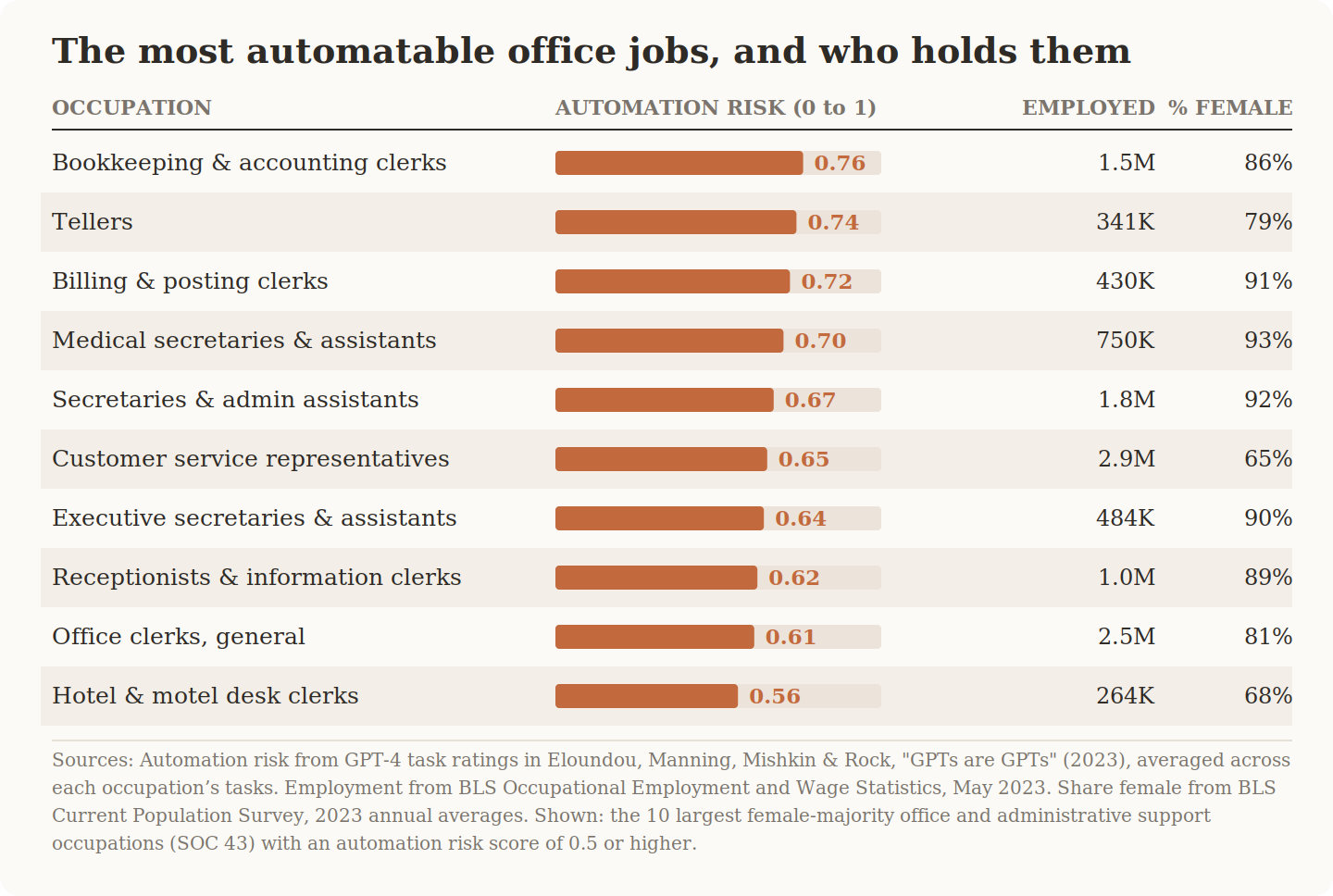
I have come to think of it as the “Invisible Disruption”: AI’s steady erosion of stable, decent-paying jobs in clerical, customer service, and back office work. Think bookkeepers, payroll clerks, HR assistants, bank tellers, administrative assistants, call center staff – the (mostly) women who keep the books, process the claims, answer the phones, and run offices. This is unassuming work, in jobs we tend to look past, rarely write about, and overlook when we make policy. And they include some of the jobs most at risk of automation.
(Here is a quick test. Try to name a single movie or TV show that features a character who holds any of the jobs listed above. Maybe you thought of Mad Men, or “9 to 5”, or another show or film set decades ago. After that, the well probably ran dry. It is hard to empathize with, or organize around, or write policy for a worker you haven’t pictured….)
Yet the silence belies the sheer scale of this workforce. They are employed in every town across America, supporting families in every community, and they number nearly 19 million, dwarfing every other occupational group in the economy. For generations, these jobs have been a ticket to the middle class for women without a degree.
AI’s threat to this work has not captured the public imagination the way it has for software engineers, Hollywood writers, or truck drivers. Nor has it provoked the handwringing we have heard about vanishing entry-level jobs. By definition, these are jobs in the background; few are public-facing. The pace of displacement, spread across individual offices one desk at a time, is subtler than a headline tech layoff, and less dramatic than the shuttered factory that rocks an entire town. And it is a trend many decades in the making, though now poised to accelerate and reach jobs that were, until now, safe.
My former research assistant Eve Devens and I spent months last year poring over the data; much of it reflected here in this post. We found that these are the best jobs available to women with a high school education, without any close competition. They are gentle on the body, upwardly mobile, decent-paying, and stable, offering the predictable schedules, benefits, and chances for advancement that separate a dead-end job from one with dignity. Importantly, they are jobs a woman can raise a family around, and retire from.
Which is why I have come to fear that AI could do to high school-educated women what deindustrialization did to high school-educated men: hollow out a whole stratum of stable, decent jobs and leave behind mostly lower-paid, more precarious work. As these middle rungs disappear, millions of women risk being left with little besides the low-wage service and care jobs that are growing to take their place. It is the kind of disruption we have lived through before, but this time, almost no one has noticed.
A 45 year career
Nine months ago I met “Diane1,” an office administrator at a financial services firm, who spoke enthusiastically about her forty-five-year career. She started in a typing pool as one of a row of young women typing claim letters off a dictaphone, in a kind of room that no longer exists. Over the next four decades she rose to executive assistant and then office administrator, gaining responsibility, seniority and pay along the way.
In speaking with Diane, I was struck by her pride, both for her accomplishments in the workplace and the independence and stability it afforded her. Three times she was named employee of the year. When Diane got divorced in her late forties, that same work let her stand on her own two feet. She was able to support herself on her income after her divorce, noting that she has owned her home, owned her cars. She told me she didn’t think she could have made it on her own had she been working instead as a waitress or a home health aid – jobs she described as low paid and physically demanding.
She is sixty-five now, close enough to retirement that what is coming will not quite reach her. But she is already watching it arrive. Her firm has begun replacing the phone lines clients used to call with chat windows, quietly automating away the human contact she spent a career providing. She will likely retire before the disruption reaches her desk, but the women coming up behind her will not.
Millions of women
More than 1 in 10 people employed in America have a job similar to Diane. It boggles my mind that “office and administrative support” is the single largest occupational group in the entire American labor force, and virtually no one studies or speaks about them. Yet nearly 19 million people work in these occupations.
Let me put that into perspective with data:
There are nearly twice as many secretaries and administrative assistants (3.2 million) as software engineers (1.7 million)
There are twice as many bookkeepers (1.5 million) as lawyers (700k)
There are nearly as many customer service representatives in this country (nearly 2.7 million) as there are truck drivers (3 million)
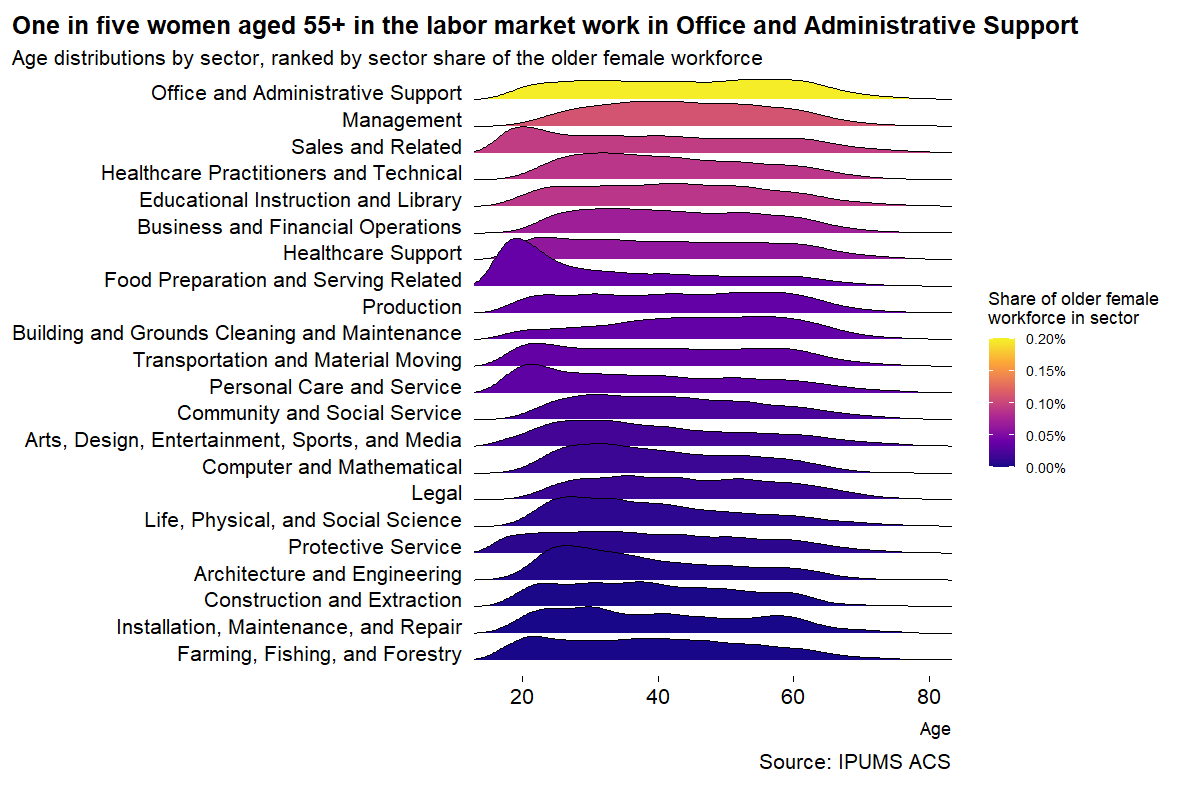
Overall, this workforce looks a lot like Diane: female (just under 3 of 4 people working in this sector are women), over 55 (nearly 40% of people working in the sector are over aged 55; one in 5 women over 55 are working in the admin sector) and high school educated (as of 2023, just under 60% of workers had a high school diploma or 1 year of college with no degree.)
Good jobs, and what replaces them
It is tempting to assume that work this overlooked cannot be worth much, but the opposite is true.
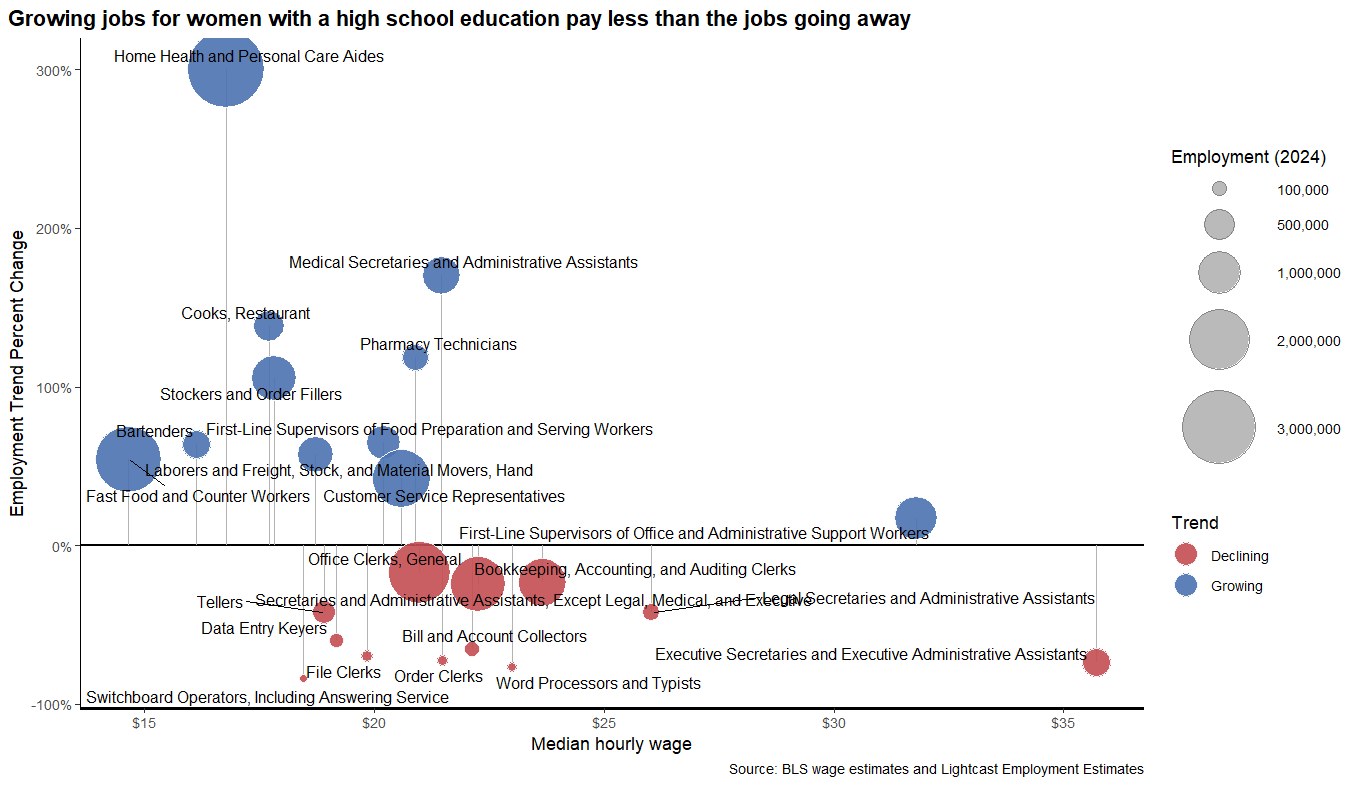
Consider a bookkeeper. She earns a median of about $49,000 a year, barely a dollar an hour below the national median wage. She works regular weekday hours in a schedule that allows her to balance work and her family responsibilities. She is likely seated during the day and rarely lifts more than ten pounds – job characteristics that matter as women age. And she has a real chance of moving up, on the strength of experience rather than a degree.
Now consider a cashier, a ubiquitous jobs for women without a degree. She earns about $32,000. She is on her feet all day. Her hours are unpredictable, often nights and weekends, set by someone else and posted at the last minute, making it extremely challenging to juggle family responsibilities at home. And she has almost nowhere to climb upwards.
Also consider home care work, the single fastest-growing job in the economy. It is much the same as the cashier role: low pay, hard on the body, few benefits, little security. The interviews I have conducted over the years with home care workers are some of the most haunting I have ever done. Most home care workers I interviewed have lived through extreme precarity – rationing medication, stretches without a stable place to live, fears of losing homes, prayers that $9/hour wages can be stretched to make ends meet.
This is the trade quietly underway, and it is the same trade that hollowed out the industrial heartland a generation ago when deindustrialization rocked manufacturing jobs: a stable, decent job swapped for a worse-paid, more precarious one. The cruel part is that the jobs most resistant to AI right now are largely these lower-quality ones in service and care. The office-based work that is gentle on the body, offers a way up and supports families is the work most automatable.
An extended period of decline
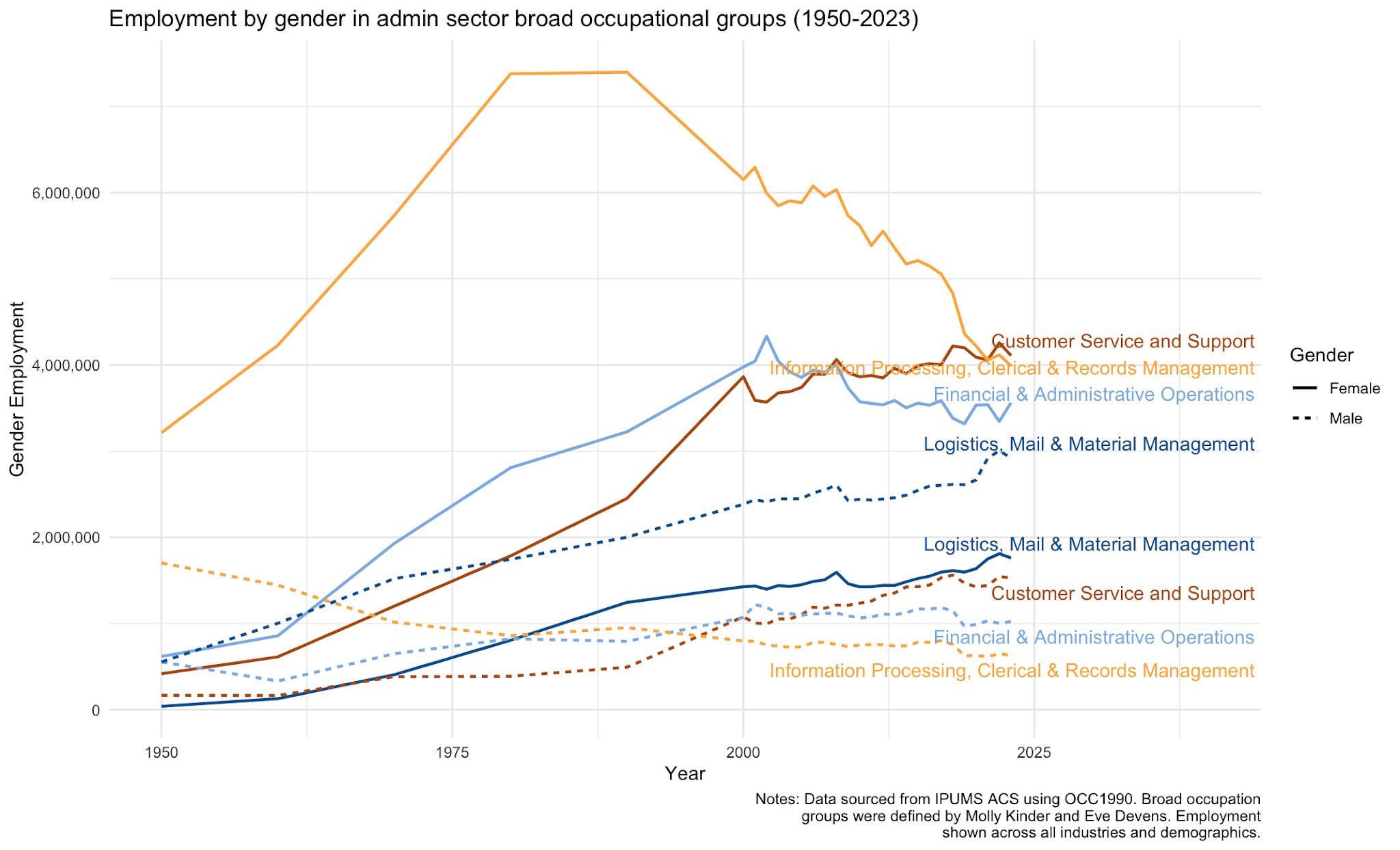
Of course, this isn’t new. The back office has been shrinking for half a century, one occupation at a time, too quietly to count as a crisis. Unlike the shuttered manufacturing plant, which traumatized whole communities, clerical automation was diffuse: one desk removed here, one role not backfilled there, scattered across every town rather than concentrated in one. The switchboard operator, the stenographer, the typing pool Diane started in, all gone without a eulogy. At its peak around 1970, nearly a third of working women held clerical jobs. By 2023, that share had fallen by half.
If this decline is so old, why fret now? The answer is that for half a century, women had somewhere to go. I worry that most of the routes that propelled them upwards are the ones AI is now closing.
The first was within the sector itself: as the paperwork jobs vanished, the jobs that required human interaction grew and offset some of the sector’s decline. Receptionists, customer service reps, the roles built on talking to people. (In the figure below, the dark red line shows customer service representatives growing from near-zero in the 1950s and 60s to nearly 3 million today.)
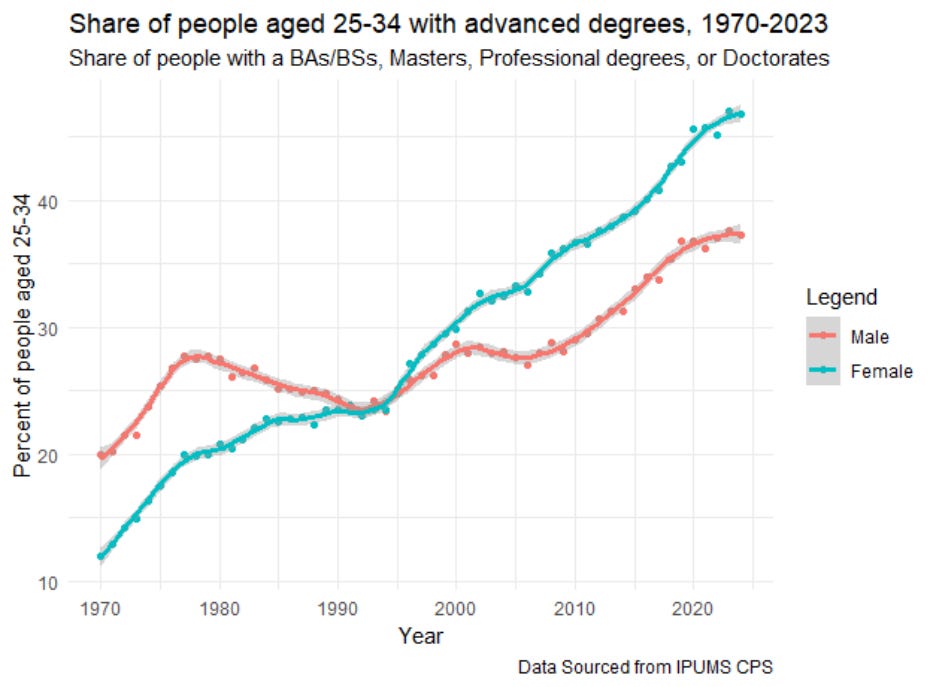
The second was education. Since the 1980s, women went to college in extraordinary numbers, outpacing men, and moved up into the professions and the white-collar middle class. (The reverse perspective of the Richard Reeves men-are-falling-behind story.)
In the figure below, as the yellow bars representing admin jobs shrunk over the last two decades, women have moved in large numbers into (green) higher paying, college-educated knowledge jobs in business, finance, management, and tech.
The third was health care, which expanded for decades and absorbed millions of women, from medical assistants to doctors (also in green below).
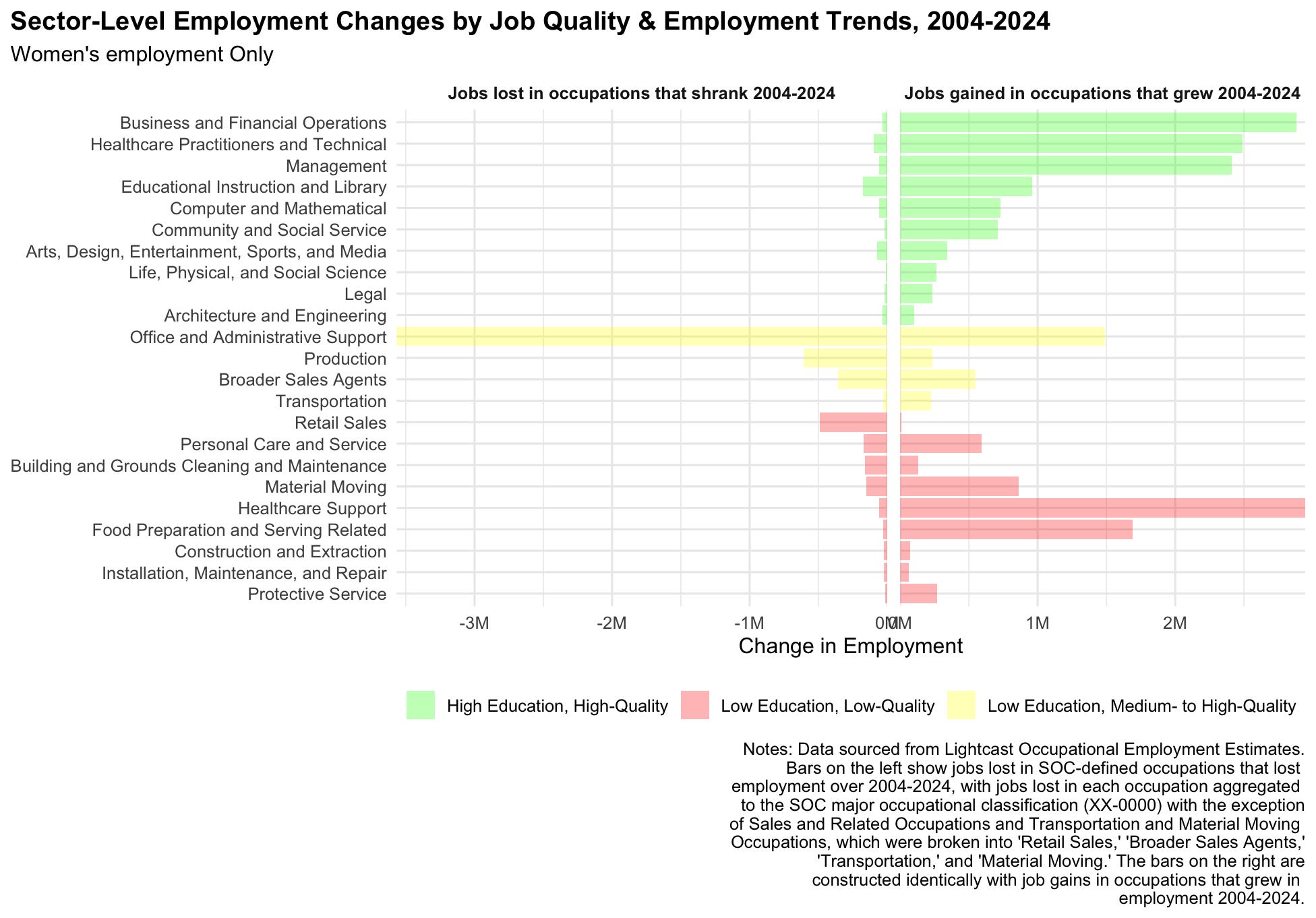
Here is what unsettles me. AI is pressing on the first two (customer service and knowledge work), while the jury is out on how AI will impact employment in the third (health care). Within the admin sector, AI is already making advances in customer service, the in-sector refuge, where Diane is already watching the phone line give way to a chatbot. At the same time, as I wrote in the Messy Middle essay, AI is poised to reverse decades of skill-biased technological change and displace the non-routine cognitive work in the white collar sectors that have been growing for decades, ironically just as women are now outpacing men in entering these well paid fields.
That leaves health care, a sector which is projected to grow overall and where the human touch and manual dexterity will remain durable for the foreseeable future even as AI advances. But can a single sector catch everyone? Even if it can, I worry that much of that work is among the lowest-paid and hardest on the body.
Overlooked, again
If this disruption has gone unnoticed, it is partly because these women have never really held our attention. For decades, as their jobs were quietly automating away, our biggest labor market interventions were built for someone else.
Consider Trade Adjustment Assistance, the federal government’s flagship program for workers displaced by the last big technological disruption. It was designed around manufacturing; clerical workers weren’t eligible for the special benefits, even across the long stretch when their jobs were disappearing too. The same skew runs through our signature federal investments of the last two administrations. The major infrastructure, clean energy, and semiconductor manufacturing programs were a (justified!) response to the scarring of deindustrialization and the loss of good manufacturing jobs. Overwhelmingly, the beneficiaries were men; women hold just 18% of infrastructure jobs, according to analysis by my former colleague Joe Kane.
The pattern holds in the tools we reach for most. Apprenticeships and the skilled trades, the backbone of American workforce policy, are paths where women remain badly underrepresented. Women are just 14% of registered apprentices. And even that number flatters the picture, because the women who do enter are typically funneled toward the low-wage end. The single largest apprenticeship occupation for women is nursing assistant ($40k/year), the largest for men is electrician ($68k/year), which is 4% women. So the standard advice for a displaced worker, retrain into a trade, was never really built with these women in mind, and where it reaches them at all, it tends to deliver them into the same precarious work they were trying to avoid.
None of this was malicious. The harm to manufacturing communities was real, and merited the scale of the policy response. But the cumulative effect is that the largest occupational group in the country, and the women who depend on it, has been a blind spot in nearly every major effort to help workers weather economic change.
The blind spot also runs through civil society too. We have built a rich infrastructure of advocacy and support around low-wage work, and rightly so. There are organizers and funders and entire well-staffed organizations devoted to care workers, to Amazon warehouse workers, to fast food and retail workers, to gig drivers. Philanthropy pours real money into these fights and efforts to improve opportunities for these workers. But the women in these clerical and administrative jobs sit outside nearly all of it. There is no major organization dedicated to lifting up their voice. They are scattered thinly across a few unions, with no real home of their own.
I learned this the hard way. For years I have been trying to interview workers in these jobs, and I could not find anyone to introduce me. For almost every other group I have studied, from screenwriters to grocery cashiers to nursing assistants, there is an organization, a union, an advocate, who is dedicated to this group and can facilitate an introduction. For clerical workers, I came up empty time and time again. In the end I found the women I talked to through a generic online research-recruiting site, the same way you might assemble a focus group to test a brand of detergent.
What needs to happen next
So what should we do? First, we need to name the problem and see these workers.
That is what this essay is meant to begin. You cannot build an agenda for a workforce you have never named, or organize around a disruption no one has noticed. Before any policy, there has to be recognition: that these 19 million workers exist, that their jobs have been quietly disappearing for decades, that they are among the best available to women without a degree, and that AI is poised to accelerate their loss.
But recognition is only the start. This moment calls for a deliberate response, designed for these women rather than borrowed from programs built for someone else: protecting the quality of the jobs that remain, easing the path for women whose work is automated away, and above all making sure the jobs growing to replace the old ones are better than the ones being lost.
That last challenge is where I am spending my energy, and where I am most hopeful. AI does not only have to hollow out good jobs. Used with intention, it could make some of the hard, low-paid care jobs that are growing into better ones. I am working on a home care pilot built on exactly that premise.
But that will not happen on its own. It happens only if we decide these women are worth the trouble.
The alternative is quieter than a crisis. No shuttered plant, no single terrible day of mass layoffs, no viral outrage. It comes one desk at a time, in offices in every town in America, as roles go unfilled. Many will land in work that pays less, demands more of their bodies, and gives their families less stability. And because it is quiet, it may stir no response at all.
That is the part I cannot accept: a country where millions of people quietly become a little poorer, a little more precarious, the economy a little less fair, without anyone ever choosing it.
Diane will retire soon, with her three plaques and a life she built from a typing pool. The women coming up behind her deserve the same chance, to do work that supports their families, lets them stand on their own, and quietly brings them dignity. The least we owe them is to notice before it is gone.
Name changed for privacy purposes
It is indeed striking how little we discuss some of these roles in the AI context vs others. The test of whether a job turns up in childrens’ books always seems like a good guide to wider public salience too…….
Looking across the categories, I wonder if it is better to consider all these roles as a group, given their silent nature + higher share of women; or better to single out specific roles, and really get a handle on how AI may affect them? Some do seem quite different to each other e.g bookeeping vs secretary (incl. more modern incarnations) vs hotel receptionists?
I think the customer service rep category is so important, given the overall trend line in your graphic, and its wider role in global employment. It also seems one of the most poorly-discussed in AI circles. (“Chatbots will automate all customer service jobs, obviously!”)
I was looking to find some evidence on customer service work and/or call centre work (which seem overlapping but also quite distinct) a couple of years ago, when people were making grand proclamations about AI automating it all. I really struggled to find anything, to your wider point here. Possibly by design!
It’s pretty clear though that the work is much more than just being able to answer questions, which it seems to be often equated to. Indeed, AI may have better prospects of automating FAQ pages than people’s roles, at least in the first instance.
The types of tasks can vary a lot, from answering a customer’s objective information-seeking question to making policy decisions to things more akin to sales/cold calling. It also seems like new technology has always historically led to more customer service demand, at least of the call center variety. And in many ways is the reason why that latter sector exists (both from an enabling point of view, and a demand point of view).
AI might change all that of course. But it also begs the question of whether AI may lead to new kinds of customer service roles (always so hard to predict).
It did make me think that we need much richer data, and stories like you have here, of what it really means to work in customer service and/or call centres, and how those role are evolving with AI.
This matches something I see from the other side of the desk. These decisions almost never get made as a decision. Nobody convenes a meeting to discuss replacing Diane’s role. It shows up as a line in next year’s budget: don’t backfill the req when she retires, the new phone system handles routing now, headcount in that department drops by one. It gets approved as a cost line, not named as what it actually is.
The deindustrialization comparison is right, but a factory closing at least forced someone to stand up and announce it. This version never reaches anyone’s desk who’s thinking about Diane at all. It just gets smaller, quietly, inside a spreadsheet, one attrition at a time, with nobody in the room who’s read what you just wrote.