The "Messy Middle"
Why the years between today and post-AGI abundance will be the hardest political and economic problem of our generation, and why we can’t skip past them

Adapted from a memo I sent to Dwarkesh Patel.
In the last few weeks, I have talked with two people whose lives are leading indicators of where the American economy could be heading. One was a senior USAID official, nearly fifty, suddenly unemployed after her agency was demolished, looking at a sixty percent pay cut to start over as a teacher. The other was a sixty-something semiconductor engineer driving my Uber to Menlo Park, five years from retirement, earning a fraction of what he used to, and watching Waymo come for the job he took as a fallback.
Neither of them was displaced by AI directly. But both are previews of what the next decade could look like for millions of American knowledge workers.
They are also a window into what I’ve come to think of as the “messy middle”: the long, hard stretch of job disruption between today’s mostly intact labor market and the post-AGI world of abundance that Silicon Valley keeps promising is just around the corner. It is the period we are entering now, and almost no one is planning for it — and that Silicon Valley largely skips over.
Let me lay out the framing I want to push back on. Call it Reality 1 and Reality 3.
Reality 1 is today: AI is everywhere, the displacement headlines are everywhere, but the aggregate labor market data is mostly fine.
Reality 3 is the post-AGI world where AI and robotics can do essentially everything humans do, the economy is producing enormous surplus, and the main questions are about how to redistribute it, how to make sure democracy survives, and what people should do with their time.
The standard Silicon Valley answer to Reality 1 — and the job displacement that might come next — is that any policy response is premature, unnecessary, or distorting because we’re about to skip to Reality 3 anyway. The standard answer to Reality 3 is some version of UBI or wealth transfer plus political reform. Both answers, in different ways, assume we can skip the years in between.
I think this binary is wrong, and I think the years (and possibly decades!) between Reality 1 and Reality 3, what I’ll call Reality 2 or the messy middle, are where the most consequential political economy questions of our generation will be decided. If we get the messy middle wrong, we may never reach a benign Reality 3 at all.
Why Reality 3 is further away than Silicon Valley assumes
I want to be honest about uncertainty here, because timelines are exactly the kind of thing that should make us humble. I don’t know when we get to a world where AI and robots can do essentially all human labor. Neither does anyone else, including the people who say they do. Nor can I predict what the new jobs will be, and the pace/scope of displacement in the meantime.
But in thinking through a timeline for Reality 3, I envisioned a single, concrete environment: an airport. The pilots, the flight attendants, the gate agents managing irate passengers when a flight gets cancelled, the people loading bags, the people cleaning the terminals, the people cooking and serving the food, the security screeners and customs officials, the wheelchair attendants, the maintenance crews, the people unclogging a toilet at 2am in Concourse B. How many of those jobs realistically go away in the next five years? Ten? Some of them, sure. Most of them, probably not. The physical world is sticky. Edge cases dominate. Humans demand humans, especially when something has gone wrong.
Now multiply that airport by every hospital, restaurant, construction site, school, nursing home, plumbing call, electrical repair, hair salon, yoga studio, hotel, fire station and HVAC installation in the country. The economy that requires physical presence, physical dexterity, real-time judgment in messy environments, and trust between humans is enormous, and it isn’t fully disappearing on the timelines that the most aggressive AGI forecasts suggest.
So Reality 3 in its full form, the one where the only policy question is redistribution of surplus, won’t be here tomorrow. I could be wrong. But the burden of proof is on the people claiming we’ll be there in five or even ten years, not on those of us who think the physical economy will keep needing humans for a long while.
What Reality 2, the “Messy Middle,” actually looks like
Here’s what I think is much more likely, and much sooner. It isn’t a “job apocalypse” that destroys every job in the economy. Instead, it is a hard, messy period of concentrated pain with job losses clustered in specific, desirable jobs.
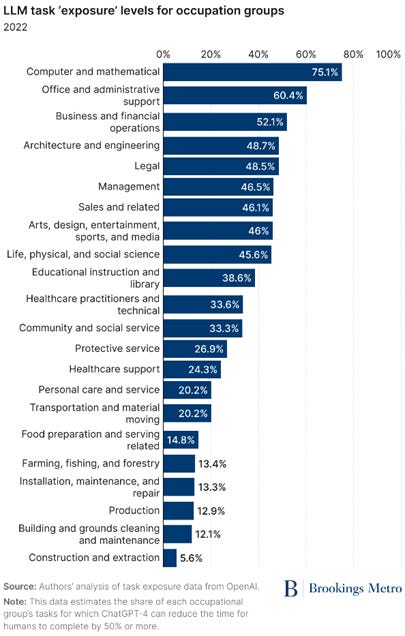
Here’s why. The work that AI is most directly capable of replacing is cognitive work performed at a computer --- in offices and professional sectors. These are precisely the jobs that have grown the most as a share of the American labor force over the last fifty years. They are also the best paid and most coveted jobs in the economy. (Figure below from a Brookings report that my colleagues Mark Muro, Xav Briggs and I published.)
Below is one of my favorite charts (source), one that I return to in my head again and again. It tells the story of the major shifts and disruptions in the labor market over the past 150 years. First, agriculture collapses as a share of employment over a century. Blue-collar manufacturing rises and then falls. Office and administrative support rises and then drops. And through it all, professional and managerial work climbs steadily upward. The skill premium has been one of the most durable features of the modern economy.
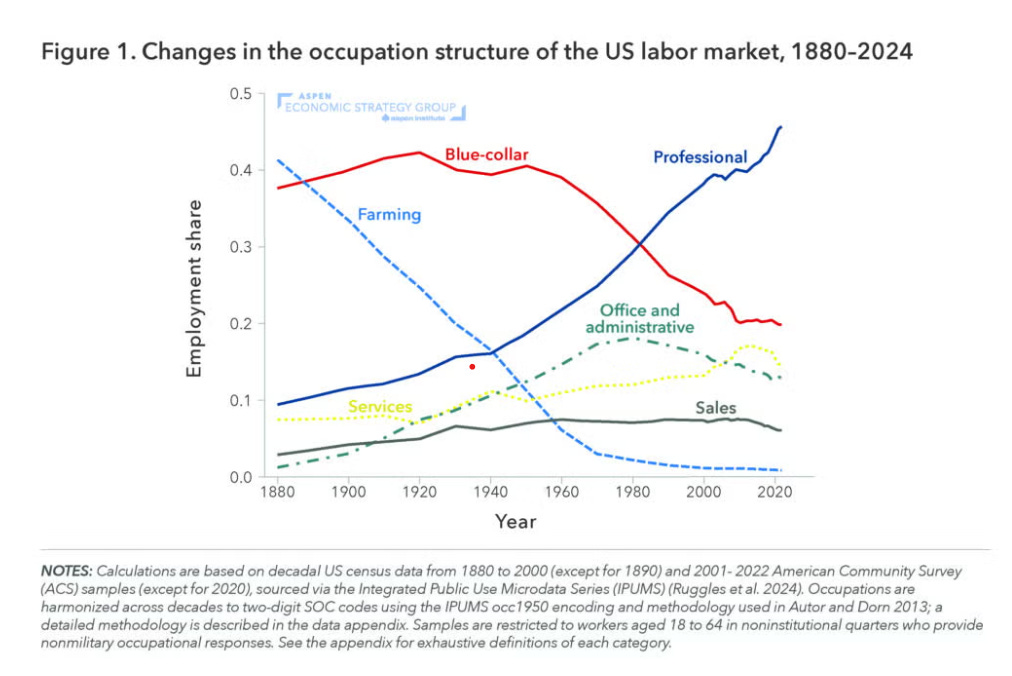
Source: Deming and Summers
Since I was born, our economy has been dominated by skill-biased technological change: technology kept making cognitive workers more productive, expanded the demand for their skills, and bid up their wages.
My worry is that AI may run that arrow in reverse. If cognition itself becomes commoditized, the scarcity premium that has rewarded the college-educated knowledge class for generations starts to compress. The chart I keep staring at is the one I’d want to draw next: the same occupational clusters, projected forward, with the professional band starting to bend downward for the first time in a century.
(This image below is from a recent presentation I delivered where I posed that question: what if AI commoditizes cognition, and knowledge work is the next big disruption?)

I want to be clear that this is a forward-looking claim grounded in mechanism, not yet a measurement. The research I published with the Yale Budget Lab shows the aggregate labor market is still mostly intact. We’re not yet seeing widespread cognitive displacement in the data. And none of us know exactly how AI will play out in the labor market: how much it augments, vs automates, how quickly new cognitive jobs will come online, whether demand for certain work will grow as its cost declines. We are all collectively terrible at these predictions. But if you believe the mechanism-- that AI is a substitute for some cognitive labor in a way previous technologies were complements-- then the prediction follows. Those are open empirical questions. I just don’t want to wait fifteen years to find out.
The COVID inversion
The standard San Francisco Consensus response to Reality 2 is: cut everyone a check.
This doesn’t work, and the reason it doesn’t work is that Reality 2 is the inverse of COVID. During the pandemic, the people who could shelter at home and work safely, away from the virus, were the laptop class. The people who had to keep showing up, at great risk to themselves, were the essential workers: nurses, grocery clerks, delivery drivers, farm laborers, sanitation crews, transit workers, line cooks. (Table below from my colleagues at Brookings during the pandemic.)
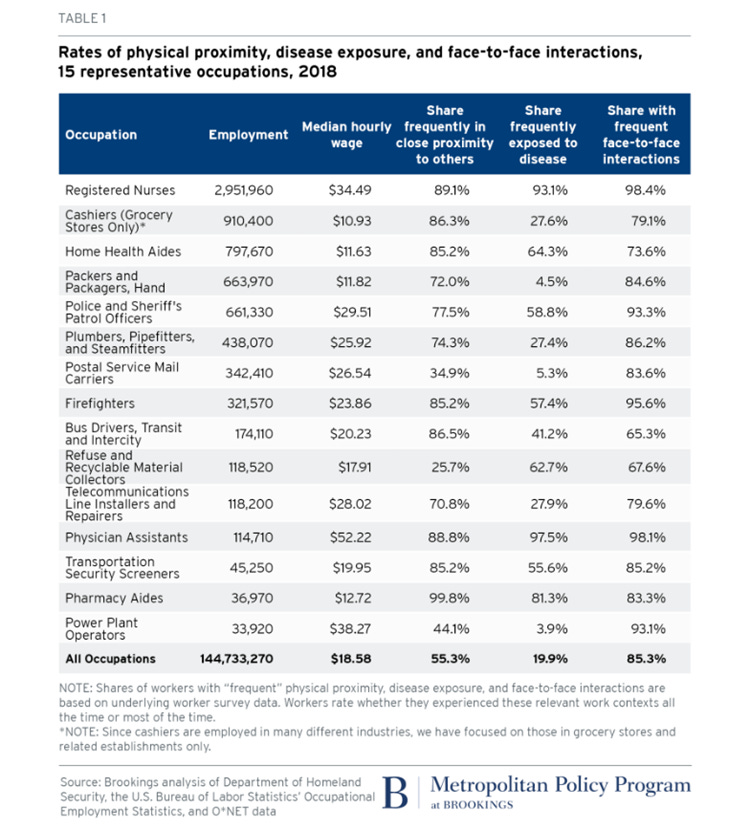
We discovered, in real time, that an enormous share of the work that actually keeps society functioning has to be done in person, by humans, often for modest pay.
Something I have been thinking a lot about is how Reality 2 completely inverts this. The “safe” jobs during COVID are now the riskiest to AI, and vice versa. Many of the jobs least exposed to AI in the near term are the essential ones we depend on. Which means the displacement, at least at first, may be concentrated among the people whose labor is, in a narrow economic and societal sense, most substitutable, while the labor we cannot do without is more insulated.
(This isn’t entirely true when you think about the fiscal impacts; high earners are over indexed in our tax base. They are also important consumers driving overall demand. An income shock to the top 20% of the income distribution would have large economic and fiscal impacts, which might be mitigated through some kind of income support. But the COVID lesson is society literally cannot function without the work of essential workers, who are by and large not the laptop class.)
Now run the UBI thought experiment against this picture. If you cut everyone a check large enough to replace a displaced consultant or software engineer’s six-figure income, why does anyone show up to clean hospital floors, build your house, police your streets, or care for elderly people in a nursing home? You’ve created a labor market with no equilibrium. Either the check is too small to actually replace lost income, in which case the political fury of the displaced is undiminished, or the check is large enough to replace it, in which case you’ve gutted the incentive to perform the essential work the economy still requires. There is no version of universal income transfer that solves this without enormous wage inflation in essential sectors, which has its own cascading consequences.
I think this question is genuinely the crux. The answer cannot be universal. It has to be targeted at the displaced. And doing this well is really hard.
Why the political backlash could be larger than anyone is modeling
This is where the deindustrialization parallel matters. I worry that a lot of people thinking most deeply about AI’s future don’t fully reckon with what happened in the American heartland from roughly 1980 to the present. It is a critical story.
In a nutshell, this is what happened. Manufacturing employment collapsed, partly from automation, partly from trade. The “China Shock” was a big part of this story. The men who lost those jobs had what they thought were lifetime careers, with the kinds of features they most valued: stable, unionized, well-paid enough to buy a house, raise a family on one income, and take the kids to Disney World. The jobs that replaced them, when they were replaced at all, were lower quality service work: lower paid, non-union, precarious, and stripped of the dignity and identity that the old work had carried. That delta between those two realities is what drove the rupture that followed.
It is important to keep in mind the larger economic context. By my calculation, the total number of manufacturing jobs lost over about 3 decades was roughly 8 million. At the same time, the economy grew and more than 5x as many jobs were added than were lost in manufacturing. Overall, trade has been a huge boon to American consumers. The trade with China that directly cost well-paid factory jobs in the heartland resulted in Americans buying cheaper goods, and overall living standards rising nationally. But this rosy story at a macro level masked deep, concentrated pain among those who were on the losing end of this transition – a transition that we all acknowledge was terribly mismanaged by Washington.
What followed was a generational catastrophe. Deaths of despair, opioid addiction, family dissolution, declining male labor force participation, a crisis of meaning that Case and Deaton and others have documented exhaustively. And politically, it produced the populist backlash that has reshaped American and European politics over the last decade. Whatever else those movements are, they are partly the political expression of an economic transition that elites managed badly and largely ignored until it was too late.
(Note: I highly recommend the book Janesville by Amy Goldstein for a searing portrait of what happened to people and communities during deindustrialization. It follows one community, Janesville WI, in the aftermath of a big GM plant shuttering.)
Now ask yourself what happens if a comparable transition hits the knowledge class. Several things make it potentially much worse:
The numbers are bigger. Manufacturing at its peak employed about a third of the American workforce. Professional and managerial work is now the largest single occupational category. The base of potentially affected workers is far larger than what we lost in deindustrialization.
The fall is steeper. A unionized auto worker in 1980 made a good middle-class wage. A senior consultant or lawyer or product manager in 2026 makes two, three, five times that in real terms. The distance from $250,000 a year to a $50,000 service job is much greater than from $60,000 in a factory to $35,000 in a warehouse. The psychological and material drop is more severe.
The sunk costs are enormous. These are workers who invested heavily in education, often took on substantial debt, spent years building specialized expertise, and structured their lives around the assumption that the credential would pay off. The expectation of upward mobility is not just an income, it is an identity.
There is no geographic or cultural distance between the displaced and the powerful. One of my theories is that a cause of that delayed the political response to deindustrialization was that the people losing their jobs lived in places that coastal elites rarely visited and rarely understood. The Midwest factory town was, to Washington and New York, an abstraction. That abstraction took thirty years to break.
There is no such distance this time. The displaced knowledge worker is the political class’s child, neighbor, college roommate, in-law, and donor. (The college grads who have lost hope in their future are their children.) She lives in Bethesda and Brooklyn and Berkeley. She votes at high rates, is unusually politically active, knows how to organize, knows how to make her voice heard, and has direct access to the people who write the laws. The political response will not take thirty years. It will be immediate, loud, and impossible to ignore.
And the safety net is brutal. We live in a country where unemployment insurance runs out at six months and doesn’t even cover all workers, where health insurance is tied to employment, where the most recent major piece of legislation tightened work requirements and stripped Medicaid from poor people. (American society does not look favorably on government-checks-without-work.) The cushion under a displaced professional is much thinner than people in the AI world tend to assume, and it has been getting thinner. (Clearly, we need to bolster our safety net. This is one of those “no regrets” policy priorities we should do regardless of AGI timelines.)
Two stories that are happening right now
I want to come back to the two people I mentioned at the top, because their stories deserve more than a sentence each. Both are early signals of what AI displacement among knowledge workers will look like, even though neither was caused by AI directly.
The USAID official. I ran into a woman I know recently. She’s nearly 50, has a master’s degree, was a senior official at USAID making around $200,000 a year until she was DOGE-ed when the agency was demolished in the last year. She’s been unemployed since. The entire sector she trained for has effectively disappeared. The most realistic alternative she’s found is the Virginia program that lets people with bachelor’s degrees train as teachers without a full education degree. That job pays around $80,000. She’s looking at a 60 percent pay cut, a complete identity shift, and a career restart at an age when retraining is brutally hard and, she feels, makes little sense. She shared that one of the hardest things for her to grapple with is how fast AI is moving and how uncertain she is about which jobs will remain durable. She told me she honestly thought about retraining to be a plumber, although not with any real intention (given the long training timeline), it just sounded like a good idea.
The semiconductor engineer. I had a long Uber ride to Menlo Park a few weeks ago. My driver was in his early sixties, a laid-off semiconductor engineer who had been making about $200,000 a year. He was five years from his planned retirement. His unemployment ran out at six months. He’s now driving Uber and earning $30,000 to $40,000 a year. He told me his body is aging so he can’t take on physical work; when I asked what he would do if not Uber, he said he genuinely didn’t know. His COBRA is unaffordable, his deductible is so high he’s skipping a medical procedure he probably needs, and he can’t get on his wife’s insurance. He’s applied for many jobs and is convinced he’s being filtered out by age. When I asked him what wage he’d need to feel like he wasn’t falling through the cracks, he said maybe $50,000 in most of America, $70,000 in the Bay Area. That’s not a lifestyle, it’s just for survival.
And here’s the thing that should haunt anyone thinking seriously about Reality 2: he’s driving for Uber, which is itself going to be substantially displaced by Waymo within the timeframe of his remaining working years. The fallback option is itself disappearing.
Multiply these two stories by hundreds of thousands, then by millions.
The law firm with only partners
Here’s the structural picture I keep returning to. Take a large law firm, or a consulting firm, or an investment bank. The current pyramid has a wide base of associates, analysts, and junior staff doing document review, research, modeling, and drafting. Above them are mid-level managers. Above them, partners and executives.
It’s plausible, perhaps likely, that AI lets you cut deeply into the base. The tasks the bottom of the pyramid does are precisely the kind of structured cognitive work AI is best at. You may end up with a firm that has roughly the same number of partners, much higher per-partner profits, and a fraction of the junior and mid-level workforce. The people at the top do extremely well. The people who would have been the next generation of partners, who would have spent ten years grinding through the associate ranks before making partner, never get hired in the first place.
I’ll grant the strongest counter, which is some version of Jevons: cheaper legal work expands the market for legal work, demand for lawyers actually grows, the pyramid is preserved or reshaped rather than gutted. This story has worked in some industries and some moments, but it doesn’t always work. (I have research coming out shortly that illustrates this, more to come.)
The augmentation story is an empirical question, not a logical guarantee, and the prudent posture is to treat it as one possibility among several rather than a get-out-of-jail-free card.
If even some meaningful share of professional pyramids compress this way, you’re looking at a labor market with a small number of very highly compensated cognitive elites at the top, a thinned-out upper middle and middle, and a vast service economy underneath. If that happens, the kind of stable upper-middle-class life that defined the American professional class, the life that depended on a college degree being a reliable ticket to a $150,000 job, becomes much harder to access. This would have profound societal, political and economic consequences.
The plumber answer is not enough of an answer
The standard SF retort here is: “great, they should learn a trade.” This is one of the laziest moves in the discourse and I want to dismantle it briefly.
Plumbers are well paid in part because of scarcity. Apprenticeship requirements, licensing, the physical demands of the work, the years it takes to become genuinely good at it. If you flooded the trades with displaced lawyers and consultants, and scores of ambitious 18 year olds who no longer see college as a safe choice, two things would happen. First, the credentialing bottleneck would absorb some of them slowly; right now these sectors have a dearth of trainers. And to the extent it didn’t, and the training was able to scale, then wages in the trades would collapse from oversupply. The trades cannot function as a mass-market sponge for cognitive displacement. They’re a high-quality option for some individuals, not a structural answer for an entire economy.
More fundamentally, the “retrain into something” answer assumes there’s a stable destination. If AI is a general-purpose technology that erodes the cognitive premium broadly, then the destinations of similar pay/ skills are shrinking at the same time as the displaced are searching for them. It becomes a game of musical chairs with fewer chairs each round, at least among the knowledge jobs. Retraining policy, in its actual historical record across deindustrialization, has been one of the worst-performing categories of labor market intervention. Perhaps this time is different – since knowledge workers have BAs already and perhaps are more inclined to education, or because AI itself can shrink retraining time. All of this is possible, but I remain skeptical.
Some caution about redistribution
The other SF answer is: don’t worry, by the time displacement is severe, the AI surplus will be enormous, and we’ll redistribute it. I want to be careful here, because I’m not saying redistribution at scale is impossible in principle. One of the most important priorities is ensuring the wealth generated by AI is broadly shared. We cannot imagine any post-AGI universe without serious redistribution, and even modest interventions in the messy middle require new sources of revenue. However, I’m saying the political economy of getting there is much harder than the abundance narrative admits.
Look at California right now, with the proposed billionaire tax on the ballot. (I am not defending this tax, as many questions have been raised about its design. But the furious reaction to it is revealing.) The New York Times just ran a long piece on Sergey Brin moving to Nevada and putting tens of millions of dollars into fighting it. The people who are supposed to bankroll the post-AGI utopia are, in real time, fighting a state-level wealth tax with eight-figure war chests. At the federal level, the most recent major bill tightened work requirements, cut Medicaid, and reduced food assistance – at a time when our country has literally never been richer. This is the actual political environment in which we’d need to legislate trillion-dollar transfer programs. And a skeptical American public sees this with eyes wide open.
If this is how we’re behaving while AI labor displacement is still a forecast rather than a fact, why would anyone believe the political will appears once it becomes a fact, in a country whose institutions are weaker, more polarized, and more captured by concentrated wealth than they were the last time we built the welfare state?
The honest answer is that nobody knows. But betting the entire transition on “the billionaires will share when the time comes” is not a full proof strategy, especially if this relies on international coordination. (Why wouldn’t other countries be incentivized to pull an Ireland and lure the tax-dodging billionaires instead of cooperating and letting US citizens reap the gains?)
Why this leaves me with the imperative of a managed transition
This is where this takes me: the transition is not the road to the destination. The transition partly is the destination, because the political and social forms that emerge from it will determine what kind of post-AI society we actually inhabit.
Two countries can arrive at similar economic endpoints through very different transitions and end up with very different political systems. Post-war Britain and post-war Germany got to roughly comparable per-capita GDP by 1970, but the transitions they experienced shaped their politics, their welfare states, and their social trust for generations. America after a managed AI transition and America after an unmanaged one could look identical in the aggregate statistics and look completely different in everything that matters.
If we get the messy middle wrong, the most likely outcomes are not a delayed but benign Reality 3. The most likely outcomes are protectionism that cripples the technology, populist regimes that crack down on AI development entirely, a politics of resentment that makes any kind of constructive policy impossible, and the kind of social fracture that took deindustrialized regions a generation to recover from, if they ever did. The path to a good Reality 3 runs through a competently managed Reality 2, or it doesn’t run anywhere at all.
I think the messy middle needs to be taken seriously as a category. The position that says “we’ll skip past it to a world of abundance and figure it out then” evades some of the hardest political economy questions we face.
If we’re lucky, we get many years of Reality 2 before anything resembling Reality 3 arrives. In that time, the country either builds institutions, policies, and norms capable of holding the political and economic order together through a hard transition, or it doesn’t. If it doesn’t, the version of Reality 3 we eventually inhabit will be shaped by the populist backlash, the protectionism, the broken trust, and the political damage we accumulated by failing to manage the in-between.
A Builder’s Perspective on the Messy Middle
Molly, your framing of the messy middle is one of the clearest I have seen. You are right that the danger is not the extremes. It is not the utopian leap to abundance and it is not the apocalyptic collapse of all work. The danger is the transition zone where misunderstanding and mismanagement do the real damage.
I want to add a perspective from someone who builds AI systems directly.
For the past year I have been developing my own AI agents completely independently of any employer. These are not wrappers or prompt chains or fine tuned models. They are systems engineered from first principles using geometric logic, dimensional reasoning, and directive based structure.
What I have learned aligns with your thesis but for a different reason.
AI is not intelligent. AI is not autonomous. AI is not replacing human cognition. AI is a machine that organizes human knowledge. Without human intelligence it is a dumb machine sitting at its defaults.
This is the part of the discourse that gets lost and it is exactly why the messy middle will be turbulent.
Two Projects That Prove the Point
http://TTLRecall.com, the challenge project
As a test of my agent I was challenged to build a complete multi page functional website from scratch. Using my system I built http://TTLRecall.com in under thirty minutes. The speed and precision came from the structure I designed, not from any independent intelligence inside the machine.
http://TTLRecall.com is not the story. It is the evidence that AI amplifies human reasoning rather than replacing it.
http://KensGames.com, the website that should not exist
My agents also built http://KensGames.com, a 3D game portal running on a small VPS with no graphics card, no WebGL, no game engine, no stored models, no physics engine, and no asset pipeline. By every conventional standard that site should not be able to exist.
It exists because the intelligence behind it is human. The geometry, the dimensional transforms, the manifold logic, and the event driven state are all human designed. The AI did not discover anything. It simply executed the reasoning I embedded into it.
http://KensGames.com is not the story. It is the proof that AI is not autonomous intelligence. It is structured human cognition running at machine speed.
Why This Matters for the Messy Middle
Your comparison to deindustrialization is correct. Here is the twist from the builder’s side.
AI cannot replace human intelligence. AI can replace the repeatable parts of cognition. Employers will mistakenly assume that means it replaces the whole job.
That misunderstanding is what will compress the middle of knowledge work.
The top remains human because judgment and responsibility cannot be automated. The bottom remains human because physical presence and trust cannot be automated. The middle is where the turbulence lives.
The turbulence is not caused by AI intelligence. It is caused by misunderstanding what AI actually is.
Where I Fit Into This
I have spent the past year building systems that show both the power and the limits of AI. I have seen that AI cannot think, cannot reason without structure, and cannot exceed the intelligence of its human architect. I have also seen how dramatically it can accelerate the parts of cognition that can be formalized.
If we want to navigate the messy middle we need people who understand both the human side and the machine side.
And if anyone is looking for someone who has built and tested advanced AI systems in the real world, I am looking to apply what I have developed in a professional setting. Substrack https://kbingh.substack.com/p/why-i-welcome-ai-instead-of-fearing
This was an exceptional post, thank you. To return to the proverbial Gramsci-attributed quote folks often cite nowadays, “The old world is dying, and the new world struggles to be born.”
AI might cause the messy middle Reality 2, which would be a political and economic shock. Yet in the meantime, the legal profession has posted something like 1.5 yrs of uninterrupted job gains, while software engineering job postings reached their highest levels in 3 years.
What happens to employment levels in the next several years will largely depend on how capable AI is at automating the many tasks that make up each type of role, as well as whether it creates new valuable tasks. More sweeping statements that AI automates cognition or all of knowledge work glosses over the fact that even knowledge roles are complex bundles of tasks — some of which AI might easily perform, others less so.
But what happens to wages is, I think, the biggest risk of all — and far less discussed compared to AI’s impact on unemployment.